LIN MA HANG MINES|2026.10.02
Environment
From Bali back to Hong Kong, I quickly felt the impact of my surroundings once again. The space felt narrower, the pace more hurried, while the distance between people somehow felt greater.
Earlier this year, when I was still in Hong Kong, my emotions were in a state of constant turmoil. To forget the people and things I disliked, I would head into the mountains every week to explore. I even began developing a project called Namaste, an attempt to explore the relationship between humans and nature through Hong Kong’s extreme weather. The waterfall meditation shoot was the beginning of this project.
Later, as my emotional struggles became increasingly difficult, I had no choice but to leave Hong Kong and spend some time in Bali. The healing effect Bali had on me was beyond anything I had imagined. My anxiety and fear gradually disappeared, and I began to feel that I could once again realise my potential.
This time, I did not plan to stay in Hong Kong for very long. During that brief month, I was fortunate enough to work with Macy, and I am deeply grateful for the opportunity.
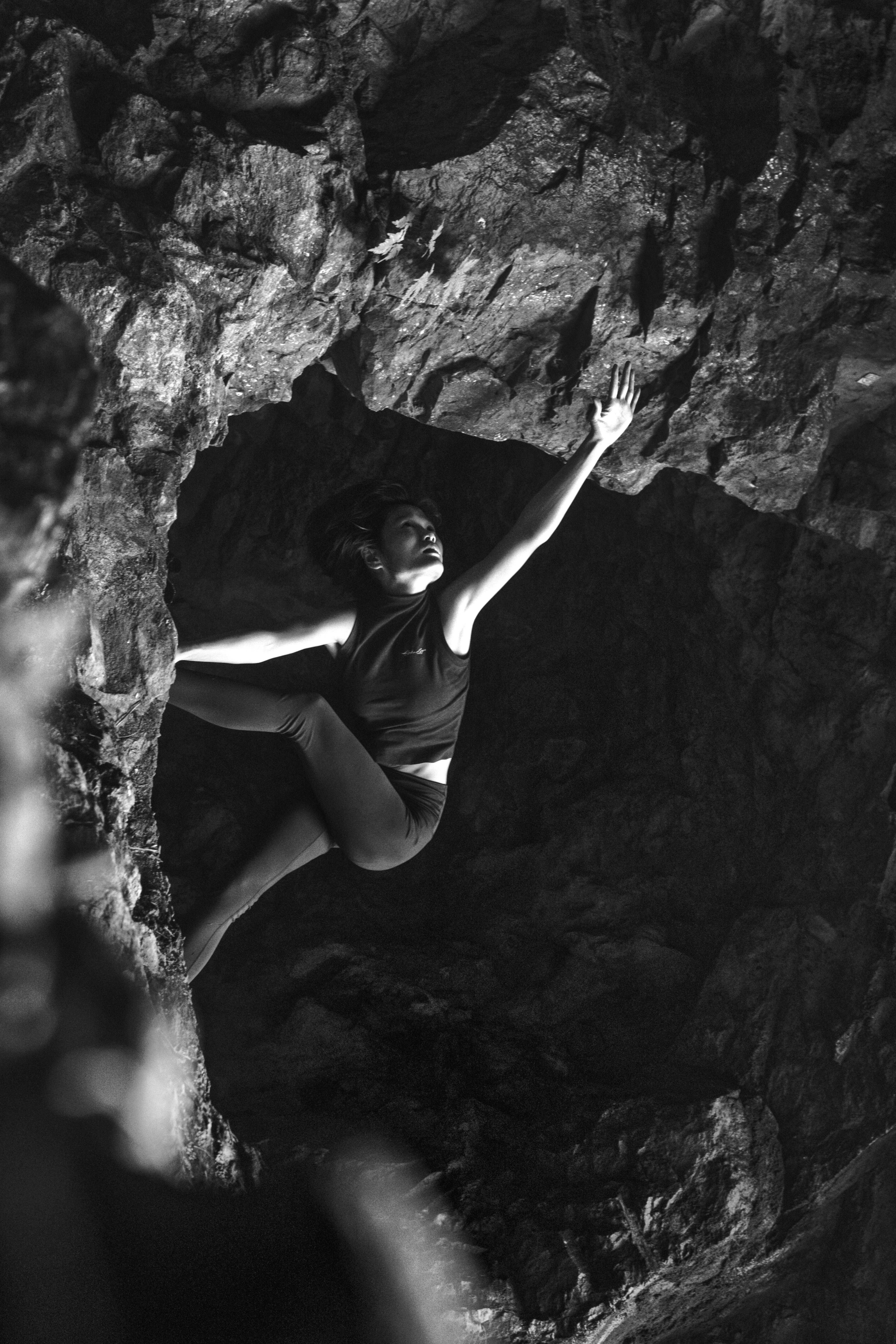
The location for this shoot was the Lin Ma Hang mine caves. I had actually scouted the location before leaving for Bali. I was drawn to the contrast between the hardness of the rocks and the softness of the yoga poses, combined with the shadows cast by the intense sunlight. I believed they could create something visually compelling. So, on a bright, sunny afternoon, we took a minibus from Sheung Shui and made our way there.
Once we arrived and everything was ready, I invited Macy to meditate inside a small cave. Then I began observing the surroundings.
Originally, I planned to follow what I had envisioned during my location scout and photograph the layered structures inside the cave. But the sunlight was completely different this time. It did not illuminate the entire main cavern, and water was constantly dripping from various parts of the cave, something I had not anticipated at all.
There was no time to waste, so I abandoned my original plan and adjusted my approach according to the conditions on site. The difference in light between the inside and outside of the cave was simply too great. I could never preserve the layers of the rock while also achieving the natural light and shadows I wanted. I changed my position and camera angle again and again, even lying down on the sharp gravel, but I still could not find the image I was looking for.
I had come here because of the cave’s complex structures. If I could no longer photograph them, did that mean I had to give up?
I saw that Macy was still inside the small cave, completely absorbed in her practice, moving through different poses as though she had forgotten everything around her. At that moment, I realised that perhaps I did not need to remain attached to what I had originally intended to photograph. So I walked out of the main cavern and began looking at this person from a completely different perspective.
Outside the main cavern, the light was simpler and more abundant, and there were none of the intricate rock formations that had initially drawn me there. It was certainly possible to make a clear image in those conditions, but a clear image does not necessarily make a good photograph. So I kept moving, kept searching.
Eventually, I reached a sloping path between the main cavern and the small cave. Using the rocks along the slope as my foreground, I photographed Macy practising yoga inside the cave.
After taking the photograph, I felt that I had somehow found what I was looking for, yet at the same time, I had not. It was elusive, almost as though it existed and did not exist at once.
Back inside the main cavern, I rotated the photograph.
That was it.
On the way back, Macy mentioned that compared with the waterfall we photographed last time, this place felt much calmer and more substantial. In that moment, I realised that beyond what we see, we are also affected by the weight and presence of a place itself.